
The Monroe County Arrest Log
Start with the Sheriff's Law Enforcement Services page. It posts a link labeled "Weekly News Blotter." That link opens the same Zuercher root the jail lookup uses. It is not a dated PDF or a permanent county archive. The portal itself controls how far back the window reaches. Monroe County publishes no fixed day count, roll-off schedule, or guaranteed posting hour.
Treat the blotter as a shifting public-safety view. An older arrest item can drop away. Its booking jacket and court case live on elsewhere. Someone sitting in jail right now may never show a matching news entry. So don't read "weekly" as a promise. Every arrest from the past seven days may not appear there.
How to Read the Monroe County Blotter
A Monroe County blotter search should keep three things apart: the date range, the custody state, and the final court result. Always work from the newest official source toward older records.
- Open the Sheriff's Law Enforcement Services page and select Weekly News Blotter.
- Review the available Zuercher functions and date information shown by the live interface.
- Match the name, agency, booking date, and charges. Do not rely on a name alone.
- Check the current inmate view if present custody matters.
- For an item outside the visible window, request the booking or arrest record from Sheriff Records.
For a booking still being processed, the Arrested Today page is the better route. The weekly blotter serves a multi-day view, not minute-by-minute confirmation of who got arrested.
What an Arrest-Log Entry Shows
Monroe County's interface is dynamic. The county lists what an entry may contain rather than guaranteeing a fixed set of fields. An older county census records the local terms that can help a reader parse a returned arrest record.
| Field | How to read it |
|---|---|
| Name and JID | Identity and jail number; verify both when possible. |
| Book date and time | The jail intake event, not necessarily the incident time. |
| Arresting agency | The office that supplied the person and charges. |
| Charge code or description | Accusations recorded at booking. |
| Bail or bond | A procedural figure, not proof of payment or release. |
| Court and court date | The next listed stage, which may later change. |
| Photo | May be present, but the county does not guarantee one for each entry. |
The portal's own labels always control what a row means. Never read a charge row as a final disposition; a later court file can show reduction, dismissal, plea, trial, or another result.
Weekend and Holiday Arrests
No Monroe County source promises a special weekend, Monday, or holiday upload cycle. That holds for arrest records. Bookings do cluster over nonbusiness days. But intake and public posting can happen at very different times. Don't call a Monday entry a Monday arrest unless the record itself carries that date.
A delayed item can surface after an earlier search. A released person's current-custody row can vanish just as fast. Check the booking time, not the day you opened the page. For urgent status, call inmate information at 734-240-7430.
Archives and Retention
A portal's visible span is not the government's retention period. Michigan General Schedule 11, item 11.210, covers jail inmate jackets. They may hold intake papers, booking cards, mug shots, arrest cards, court papers, releases, bonds, and warrants. Keep them until release plus ten years, then destroy. Even so, that rule promises neither ten years of online display nor survival of every separate record series.
For older arrest records, begin with Sheriff Records at 734-240-7415 and the county FOIA process. Supply the name, an estimated booking date, and the JID if known. Include the exact series you want. Ask whether it is retained, transferred, or lawfully destroyed.
Note: A live roster, retained jail jacket, court register, newspaper copy, and third-party reproduction each have different date ranges and correction paths.
Monroe Arrest News Archives
Newspapers follow events, not a full booking log. The Monroe News crime section picks the stories it finds newsworthy. Recent coverage included three Monroe police arrests plus a county road-rage arrest. Each story named the jail where the person was lodged. That narrative detail is useful. Still, routine bookings often go unreported, and a story never promises a booking photo.
The Monroe News NewsBank archive reaches back to 2005. Older coverage survives on microfilm at the county library. That reel collection has gaps. There is no public index either. Search by rough date, place, and arresting agency, then check anything you find against official arrest and court records.
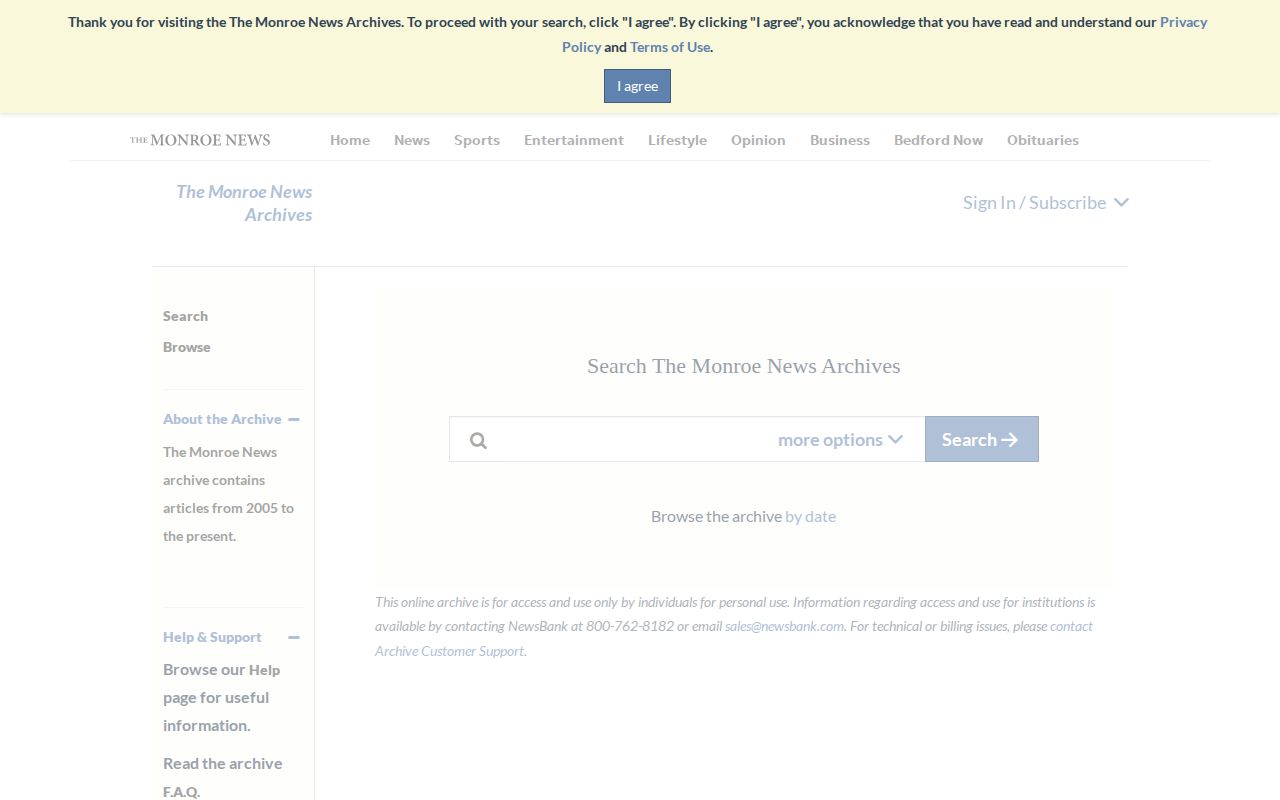
The capture documents an archive interface, not proof of any person's arrest or guilt.
Unofficial Monroe Arrest Reports
Go to official sources first. The MCJ Search arrest page is an independent Monroe-focused site describing daily activity, recent releases, and current population drawn from public jail records, and it says plainly that it is not the official jail site. Its best reminder: a person can appear in an arrest report yet vanish from current population after release, transfer, or bail.
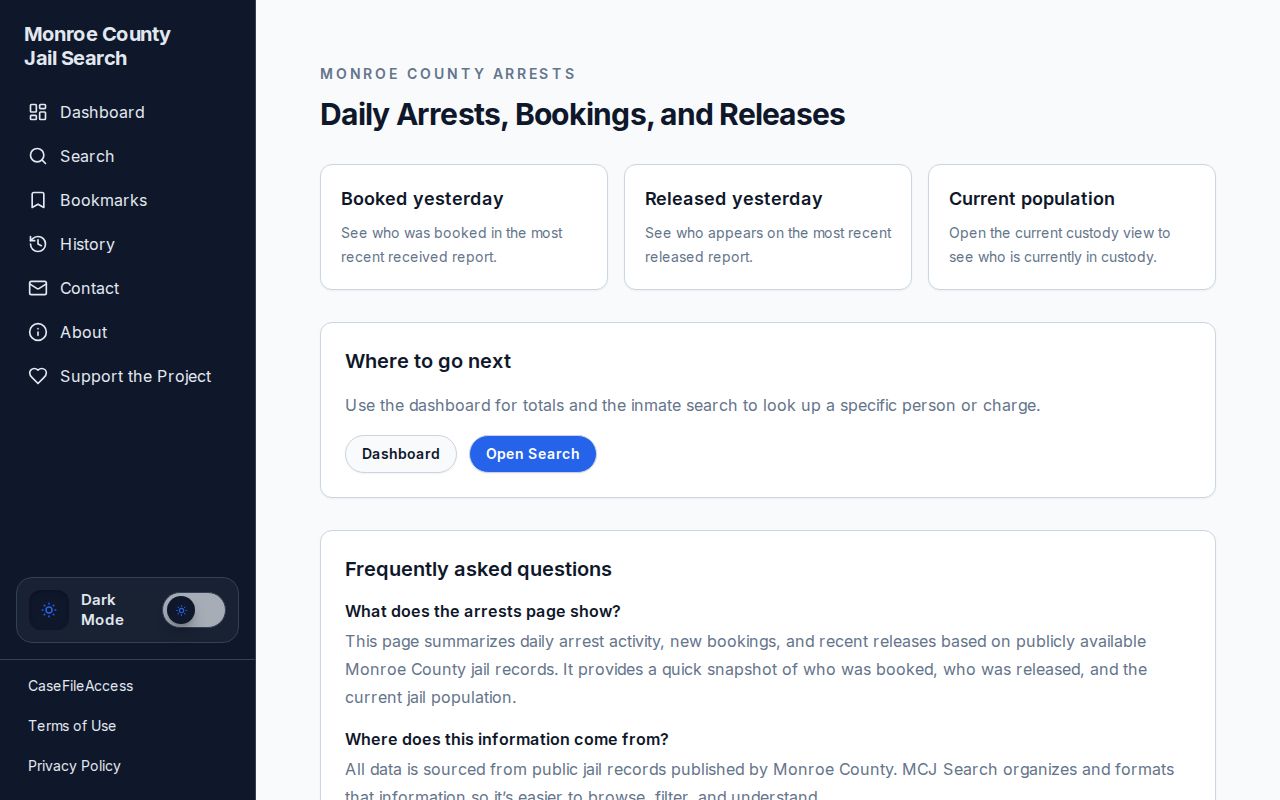
Check any secondary interface against the Sheriff and the courts, because copied facts go stale. RecentlyBooked runs a Monroe County section too. It is unofficial and makes internally inconsistent photo claims. It should never stand in for Zuercher or a records request. Arrests.org, Busted Newspaper, and Mugshots.zone list no Monroe-local page.
Monroe Arrest Reports Need Context
An arrest report shows what police alleged at booking. It is a snapshot, nothing more. Prosecutors can change, reduce, or drop charges as a case moves. Under the Monroe County prosecution outline, arraignment and bond come after booking, followed by misdemeanor proceedings or a felony preliminary examination.
For later procedural facts, use MiCOURT and the right clerk. Public court indexes can leave matters out. They are not the official court file. Confirm any important disposition directly with the clerk before relying on it.
Official Versus Copied Arrest Data
A page can look current yet carry little authority. Zuercher is linked by Monroe County. It sits first in the chain. The Sheriff's Records Division holds retained county jail material. A newspaper picks which arrests count as news. An independent site may copy a few public rows on its own update schedule. Blend these together and you get a false master log.
Two pages disagree? Check timestamps. Go back to the originating office. A copied charge can linger online after a court revises it. A news story may cover the arrest and never the outcome. The county roster drops a released person while the booking jacket stays retained. Source type explains most apparent conflicts.
Photos need the same caution. Monroe County says its official portal may show a mugshot image. Display is not guaranteed. A secondary page's picture proves nothing either way. If the image matters, request the official one.
Request Older Monroe Arrest Reports
Skip the "send everything" approach and be specific. Name the person and give approximate arrest and booking dates. Note the arresting agency if you know it. Say exactly which item you want. Choices include incident report, arrest report, booking card, inmate jacket, release record, or booking photograph. Different offices may hold these items, and each carries its own disclosure limits.
The Sheriff's Records Division sits at 100 E. Second Street, Monroe, MI 48161, and takes records calls at 734-240-7415. The county lists a card convenience fee. It posts no booking-photo-specific price and no promised turnaround, so ask for a written estimate. City arrests add a wrinkle. The city department may hold the police report. Monroe County Jail, meanwhile, may hold the booking record.
Michigan's retention schedule allows destruction once the applicable period runs out. No portal has to serve as an archive. A precise date plus a JID helps staff learn whether a record still exists. It also shows where the record lives.